Motorsport
Back to Library >
The greatest Porsche 911 of all? Part one
3 years ago

The #8 RSR won the last of the real Targa Florios
Remarkably, that wasn’t the only giant-killing feat the RSR pulled off that season. The first was the Daytona 24 Hours, won on the car’s debut at the start of the 1973 season in the expert hands of Hurley Haywood and Peter Gregg. Three months later, on a sun-baked Sicily, chassis 0588, known in the Porsche world as R6, proved that win at Daytona was no fluke by outlasting the quicker Ferrari 312 PBs and Alfa Romeo T33s to claim what remains the 911’s most famous ever racing victory.
In 2018, R6 was restored back to its original Targa Florio specification after a year-long and quite extraordinarily painstaking restoration by Porsche restorers, authorities and dealers Maxted-Page Ltd. The research phase alone took three months to complete.
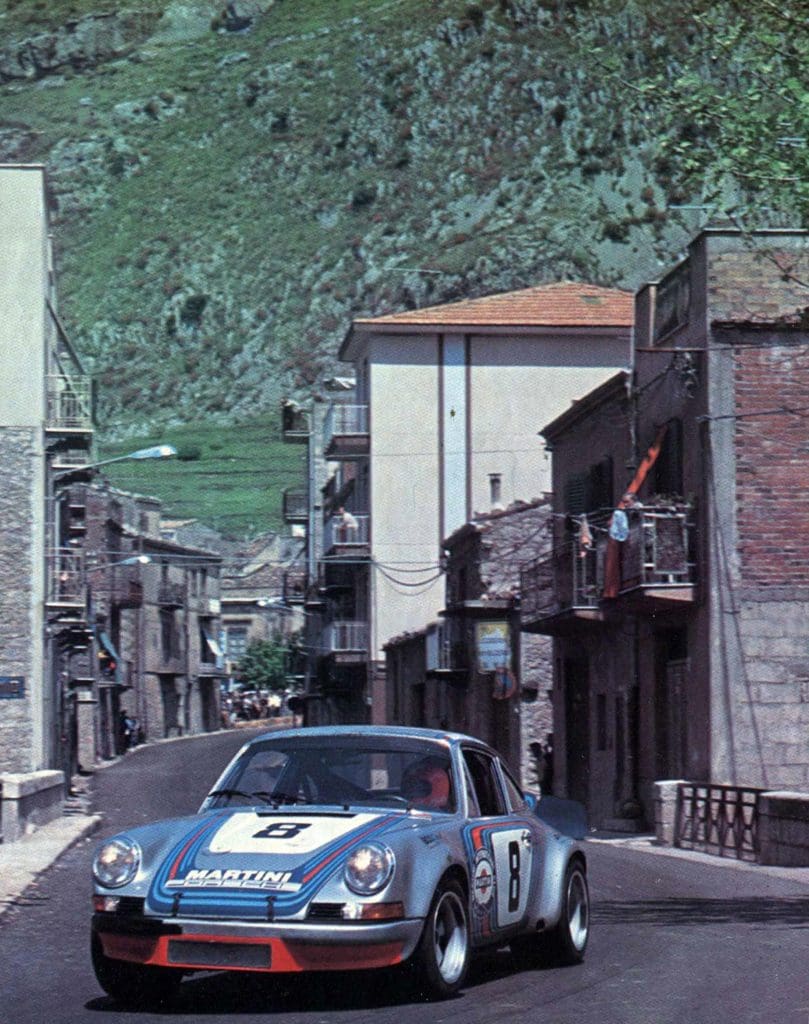
But first, we need to remind ourselves what an RSR was and how it got that way. It came about as a result of rules for 1972 limiting Group 5 race cars to a 3-litre engine capacity. That outlawed the 917 prototype, while the still eligible 908 was too long of tooth and short of power to keep up with Italian and French opposition now putting Formula 1 engines in their sports cars. Besides, new Porsche boss Dr Ernst Fuhrmann was enthusiastic about racing cars that could actually be sold to the public. Which is how the RSR and the road car needed to homologate it, the 2.7 Carrera RS, came into being.
The RSR started life at the end of 1972 with a 2.8-litre engine, but quickly swapped to a 3-litre capacity when its magnesium crankcase was changed for a stronger aluminium unit, which could therefore tolerate thinner walls between the cylinders. With twin plug heads, big valves and a 10.5:1 compression ratio it produced around 315bhp. With a widened track, race suspension and brakes from the 917, it made such a formidable weapon that for the next three seasons and almost without exception, it turned the GT category of the World Sportscar Championship into an RSR category.

"Valuing R6 is almost impossible because it is unique. If it ever came up for sale it would be worth whatever someone was prepared to pay for it on the day. A high seven figure sum for sure"
But the car was not homologated in time for the 1973 season opener at Daytona so it raced in Group 5, with Haywood and Gregg outlasting a fairly thin field of prototypes. It raced as intended in Group 4 at Vallelunga and Dijon winning the class in both, but from Monza onwards the works cars raced as prototypes, not just to keep the customers happy who might otherwise be disgruntled by being beaten by people who’d sold them their car, but also to test unhomologated experimental parts.
R6’s WSC career as a factory car was brief. It was the car that won at Vallelunga in March but, with its usual driver line up of Gijs van Lennep and Herbie Müller, failed to finish at Monza. At Spa it was first home behind the proper prototypes fielded by Mirage, Ferrari and Matra. As we know, it then triumphed on the Targa.

At Le Mans the official reason for retirement was a fuel system failure, but this was merely a somewhat euphemistic expression for simply running out of petrol. At Zeltweg it was again first car after the purpose-built racers whereafter it was leant to Roger Penske for the season finale at Watkins Glen where the power couple of Mark Donohue and George Follmer maintained its record of absolutely best of the rest behind the real prototypes. And that was that. It was sold, raced in Mexico until 1975 then stored until returned to Le Mans configuration in 1991. It was exhibited as such until the end of 2016 when its owner commissioned Maxted-Page to turn it back to its Targa-winning specification.
The good news was that as a result of its relatively quiet life, R6 went onto the operating table already in good condition. ‘It’d had what we call a 1990s restoration, which was as good as you might expect back then. But the world has moved on so far since, and what the owner wanted was the car to be as it was when it won the Targa down to the smallest discernible detail,’ says Lee Maxted-Page.
"The seats were original RSR items, but for the Targa the drivers had had a ‘lollipop’ race seat, so another had to be found. All the instruments looked superficially correct, but the oil level gauge was not period, the speedometer was a dummy and the 10,000rpm tachometer turned out to be a later electronic component, not the original mechanically driven dial. Even the steering wheel was wrong"

‘The job could have been incredibly difficult were it not for the factory which gave us unfettered access to its photographic and technical archive, and Norbert Singer who wrote everything down in period by hand and kept every word. So when we wanted to know the exact suspension ride height used on the Targa Florio, we just needed to look at the set up sheets to find the answer.’
In fact when the team media-blasted the shell back to bare metal, they found that, save for one knock on an A-pillar that needed to be straightened on the jig, R6 was in remarkably good and original order. ‘But we still had a lot of work to be done, not least because of all the changes made to the car between the Targa Florio and Le Mans. Meaning much more retro-engineering was required just to get the car back to Targa specification.
‘For Le Mans R6 and its sister R7 were taken back to Weissach and much modified,’ recalls Maxted-Page. ‘They got even wider 12in magnesium rear rims and centre-lock hubs from the 917 in steel at the front and titanium at the rear. The rear arches were enlarged to accommodate the wider rims and larger fibreglass moulded Mary Stuart collars fitted to the rear wing. The steel front wings were replaced with fibreglass while the doors were made from a kind of fibreglass not seen since the 1967 911R. And all the glass was replaced with Perspex save the front screen.’ And it all needed undoing.
Putting this right wasn’t just a question of finding some steel panels and glass. The panels were unique to the RSR and had to be exactly the right gauge throughout; the glass had to be identical to the Glaverbel glass the RSR would have had when new. Inside exactly the right needle-felt lightweight carpet had to be sourced, trimmed and reinstated. The seats were original RSR items, but for the Targa the drivers had had a ‘lollipop’ race seat, so another had to be found. All the instruments looked superficially correct, but the oil level gauge was not period, the speedometer was a dummy and the 10,000rpm tachometer turned out to be a later electronic component, not the original mechanically driven dial. Even the steering wheel was wrong.
‘Mechanically the car was in very good order but we still had to go through everything and down to the smallest detail. The engine was the correct type for the car, but fitted with slide throttle injection which appears to have been in use from Le Mans onwards. For the Targa it had butterfly throttles so those had to be used again. Likewise the gearbox didn’t really need rebuilding, but it was full of the wrong ratios. Happily we knew exactly what gears it should have had for the Targa, so those are the ratios it has today.’ When the engine was put on the dynamometer, it developed an exceptionally healthy 340bhp at 7950rpm.
If this sounds like an obsession, I am really only scratching the surface of just how detailed this restoration was. So keen that the car be not just in Targa Florio specification but identical to how this actual car was, the rear wheel arch extensions were lap-welded to the body using exactly the same techniques that would have been employed at Weissach in 1973. Maxted-Page’s team also discovered that the VDO rev-limiter unit that can be seen fixed to the rear bulkhead of the car in photographs taken on the Targa Florio had at some stage been repositioned and the original holes welded up. Needless to say the unit is back in its rightful place. Even the exterior fire extinguisher handle was moved a few inches when the bare shell revealed where the original hole had been covered.
"If this sounds like an obsession, I am really only scratching the surface of just how detailed this restoration was. So keen that the car be not just in Targa Florio specification but identical to how this actual car was, the rear wheel arch extensions were lap-welded to the body using exactly the same techniques that would have been employed at Weissach in 1973"
And then, of course, there is its iconic Martini livery. To ensure the colours were exactly right, the paintwork of R13, a 1974 RSR Turbo, was examined and the livery built up painstakingly, layer after layer, finished off by hand and brush, just as would have been done in period, to an accuracy measured in fractions of a millimetre.
‘It has been a dream job in many ways,’ says Maxted-Page. ‘Obviously the car we are dealing with is an icon, probably the single most important example of undoubtedly the world’s greatest sports car, and it was a privilege to be able to return it exactly to how it was that great day in 1973. But we only realised how lucky we were when we stripped everything back and saw what incredible condition the car was in. Many racing cars get crashed, modified and rebuilt so many times it is sometimes hard to know how much of the original is left. But with R6 the shell was almost perfect, the bonnet original and even the rear wings which we thought it had acquired later turned out to have belonged to the car from the start. So when you look at R6 as it is today, it’s not just like R6 as it was then, in the most important ways it is R6 as it was then…’
Indeed Maxted-Page concedes that the RSR is now far too good to race. ‘There’s not much it’s eligible for and why would you want to risk it? Damage it and you’re damaging the history of the most important racing 911 of all. Why chance it?’
Valuing R6 is almost impossible because it is unique. If it ever came up for sale it would be worth whatever someone was prepared to pay for it on the day. A high seven figure sum for sure. Maybe more.
And nor does it seem that important. For me it matters far more that when you look at it now, you know you’re looking at the real deal, right down to the last nut, screw and bolt. And, in all likelihood, that is the way it will now remain forever.
In Part 2, published tomorrow, Mel Nichols recalls travelling to Sicily to watch the RSR win the last World Championship Targa Florio before Karun Chandhok gets behind R6’s wheel for a flat-out blast around Goodwood
With thanks to Lee Maxted-Page for helping with this story

