Features
Back to Library >
The accidental hero
5 years ago

The ancient Greeks had been moved to build a glorious theatre on these cliffs. The Romans duly rebuilt it. Later, German and English hedonists relished Taormina’s attractions too. Kaisers and kings stayed in this very hotel.
How befitting the setting seemed for the Cosworth – the fastest Ford saloon yet built, designed in Germany by a Belgian assisted by a Japanese, engineered and powered by Britons and built by Belgians for automotive pleasure seekers across Europe.

The Sapphire RS Cosworth took over from the big-winged three-door hatchback, a car created for and designed to achieve the 5000 sales required for Group A homologation. In fact something over 5500 were built, with 500 becoming RS500s, among whose many victories can be counted the Manufacturers’ title in the 1987 World Touring Car Championship. And while, by contrast, the Sapphire was a full production model with a tame-looking four-door body, it lost nothing in performance to the homologation model and gained plenty in refinement. It moved the Sierra Cosworth into another realm where it could not only rival the compact fast saloons of Mercedes-Benz and BMW but, frankly, beat the lot of them.
Yet, in one of those motor industry vagaries, we now know the four-door Sierra Cosworth was created by accident. Its designer Luc Landuyt had started it as a facelift for Harm Lagaay’s original three-door Cosworth, but when it came time to make a clay model there wasn’t a three-door buck available.
‘To avoid wasting time, we started modelling on a four-door saloon,’ Luc reveals in the book Secret Fords Volume One.‘The car pleased a lot of executives who came to see it and slowly the idea of doing this four-door type of Cosworth, rather than a two-door, emerged – and the never-to-be four-door Cosworth made it to production!’

Luc’s restrained decklid spoiler enhanced the notchback tail and nicely complemented his nose section, which was better-integrated than that of the three-door RS Cosworth. He was disappointed his original design’s flared wheel arches and Mercedes-like lower side cladding were ditched, but the car retained just enough visual presence to reflect its performance.
The cabin still looked too much like a sales rep’s Sierra but Ford’s interior designers added Recaro seats to a near-perfect driver environment that boasted an ideal reach to the wheel, pedals, and leather-topped gear lever. So if you looked beyond appearances and badges, you found a good place to work.
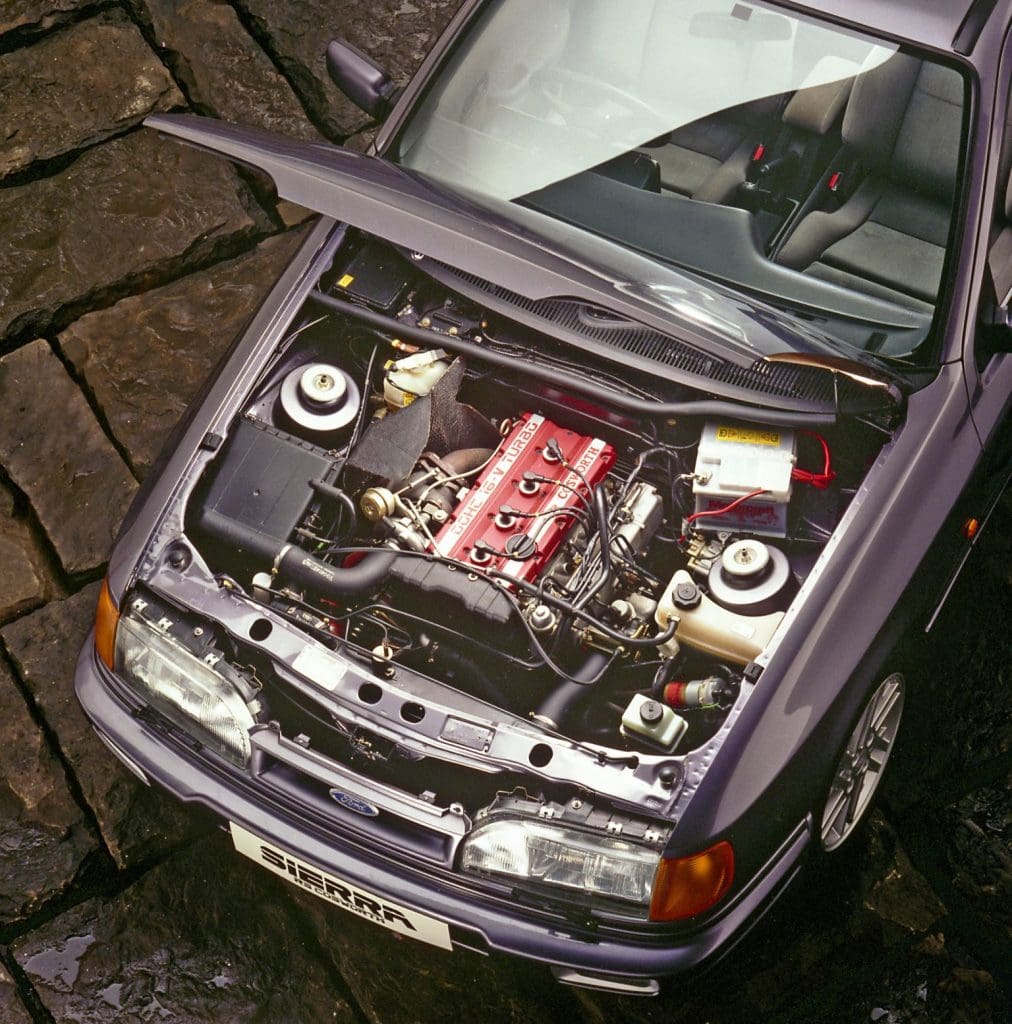
Powering the Sapphire was the familiar 1993cc four-cylinder engine – Ford’s T88 cast iron block topped with a Cosworth-developed light alloy 16-valve head and turbocharged by a Garrett T3 – but with improvements. It developed 204bhp at 6000rpm and 203lb ft of torque at 4500rpm. At least 80 per cent of the torque was available from 2300 to 6500rpm. That enabled 0 to 60mph in 5.8 seconds and a top speed of 142mph, Autocar would record: enough to embarrass the Mercedes 190E 2.3-16 and BMW M3.

The variable-rate power steering automatically quickened its ratio as lock was applied. It was light and swift, good for in-town manoeuvring and for fast work on open roads. The clutch was pleasantly light too. The gearshift, working a rugged close-ratio Borg-Warner five-speed, was notchy but blended in well enough.
Despite Rod Mansfield’s taut Ford SVE team working hard on things like the engine mounts during the Sapphire Cosworth’s year-long development, there was still some vibration – especially through the gear lever – that betrayed the potently tuned four’s humble roots. Although the overall refinement was better than earlier Cosworths’, there was still enough buzz as the revs rose to prompt an upshift at around 3500rpm in normal, quiet driving.
But there was nothing fussy about the engine’s behaviour. It didn’t mind dribbling in traffic or easing down narrow streets at less than 2000rpm. It didn’t suffer much lag either.

Opening up revealed just a moment’s soft response from around 2000rpm. Then came a meaty thrust, swelling to full potency by 3000rpm. Thereafter the power flow stayed even and strong, giving the sort of performance that let you decide whether you’d change up early – at 5500rpm, say – or wring it out for the savage sounds beyond 6000rpm.
From 6500rpm the electronic management began to ration fuel until it chopped it all off at 7000rpm. The first four gears gave you a handy 42, 64, 93 and 124mph at 6700rpm.
As good as the Cosworth felt on a motorway, it was on a two-laner like the road weaving west around Etna that it showed its heart and soul. It wasn’t only fast; it was composed. A lower front roll centre and, surprisingly, slightly stiffer springs, made the Sapphire RS feel better balanced and less nervous than its race-orientated older sister. It turned into bends less snappily but quite sweetly, with strong grip and negligible understeer – it was only 10kg heavier than the two-door RS and rode on the same 2608mm wheelbase.
The steering didn’t feel razor sharp but it was accurate, and a driver could delight in tanking on through a series of demanding bends where the clean responses from the wheel complemented progressive and powerful anti-lock brakes.
Pushed hard, the Sierra rolled modestly but evenly, with enough grip to take a lot of its power – or, in a more open bend, a lot of speed – before the tail budged. When the 205/50 VR15 Dunlop D40s did let go, there was no bother about catching it; it came back quickly and tidily. Ride and handling chief Mick Kelly, one of the six engineers Mansfield had chosen to found SVE with him 1980, had done his job well.
Sharp bumps prompted a thump from the trailing-arm rear end but over badly broken surfaces – not uncommon near an active volcano – the poise remained. It added up to a saloon that was fluid and impressive, as satisfying and safe to drive as it was fast. When I braked hard into one tightening downhill off-camber bend, the Cosworth maintained its line without a twitch. Mid-bend, it stayed phlegmatic when I needed to swerve around a large lump of lava Etna had disgorged.
All of this left me, after several hours of driving, disappointed to see a sign I should have welcomed: Taormina. I wanted to go on running the feisty Cosworth hard, enjoying its power, pace and seductive handling. I valued the fact that it was more refined and comfortable than its whale-tailed predecessor and, I thought, better-looking, too.
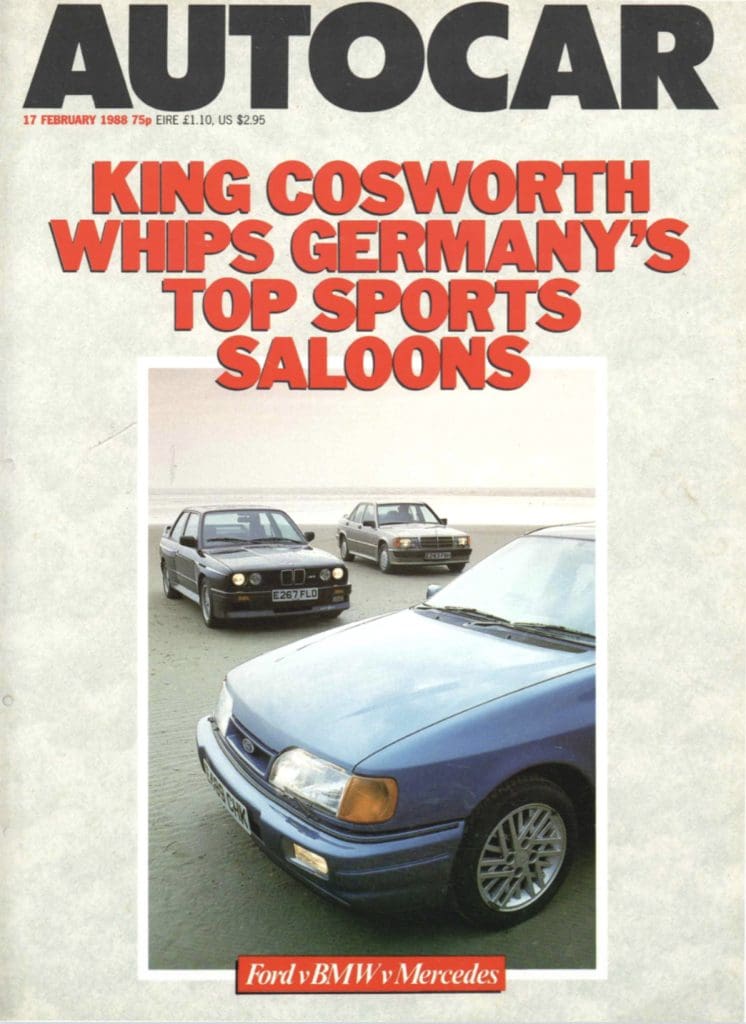
Shortly after that sybaritic weekend in Sicily I was pleased to learn that the Sapphire Cosworth was as good as I’d thought. In the UK, Autocar pitted one against an M3 and 190E 2.3-16 over 900 miles and declared it better in almost every way.
With its conventional body and subtle wing, the Sapphire might have been overshadowed as an icon by its look-at-me hatchback predecessor, but would appeal to many more buyers who preferred their fast Fords to be more discreet. Indeed, with 26,089 two and four-wheel drive Sierra Sapphire RS Cosworths built between 1988 and 1992, the Cosworth that wasn’t meant to be turned out to be one of the most successful RS Fords of all. Quite right too.

