Features
Back to Library >
Drivers versus cyclists
3 years ago

Cycling on a quiet road can be spiritual, says Gavin
Among motoring writers, fellow Ti contributors Henry Catchpole and Colin Goodwin are keen cyclists. So is James May, although Goodwin tells me he’s slow up hills. Doug Blain, editor of Car magazine in the 1960s, rode around London on an ancient Sunbeam bicycle.
Russell Bulgin, eminent Car magazine columnist from the 1980s and ’90s, got me into cycling. Russell was a keen rider and his bikes were handmade by storied frame maker Roberts of south London. He also owned a folding Moulton, designed by the man who conceived the original Mini’s rubber cone suspension.
Since that cycling epiphany, I have commuted in London for 20 years (once spending an afternoon in St Thomas’ Hospital after being hit by a Nissan van). I have ridden numerous times up Mont Ventoux, the Col du Galibier, Alpe d’Huez, the Col du Tourmalet and many other iconic Tour de France climbs.

"I once rode a single-speed fixed-wheel bike around London. I believe this qualifies me as a hardcore cyclist. But I am also a car enthusiast to my very core: I have loved cars all my life, loved driving them, loved racing them. Most of my living to date has come from writing about them"
In 2013 I rode with Sir Bradley Wiggins in Italy when he was training for the Giro d’Italia. I have ridden six Etapes du Tour (an amateur bike race, held on a single mountain stage of that same year’s Tour de France) and once competed in the Marmotte (keen cyclists will know it: an iconic French amateur bike race involving 5200 metres of mountain climbing in a day). I own two Colnagos (the Ferraris of push bikes; one is a classic 1980s steel bike), two Condors (fine British-designed, Italian-built bikes) and a titanium Dutch bicycle for winter miles. My daily rider is a 25-year old Cannondale, one of the last hand-built in the US before production moved to the Far East.
I once rode a single-speed fixed-wheel bike around London. I believe this qualifies me as a hardcore cyclist. But I am also a car enthusiast to my very core: I have loved cars all my life, loved driving them, loved racing them. Most of my living to date has come from writing about them. And I, and thousands of others prove every day, there is no conflict between being a lover of both cars and bikes. On the contrary, perhaps the first point to appreciate is what joins the car and bicycle communities together – the freedom afforded by the open road – rather than what at times might seem to set us apart.

For myself, when I am on two wheels I obey the speed limit (nearly always), traffic lights (without exception) and am unfailingly courteous to other road users. Lycra louts who jump lights annoy me. I never swear or curse at riders or drivers.
I ride partly for the thrill. Nothing compares with the unfiltered excitement of a fast descent on a sliver of carbon, balancing on a couple of finger-thin tyres. I once did 90 km/h (cyclists always talk in metrics) down the Col du Galibier. I assure you that feels faster than any Ferrari at 200mph. In my experience, only downhill skiing compares.
But it’s not just the alfresco thrills. There is pleasure from meandering down a hedgerow-lined country lane, imbibing the smells of the season, your skin caressed by the passing breeze and the gentle British sun. In a car, you’re insulated and isolated from the joys of our world. On a bike, you’re part of nature.

There is something deeply spiritual about riding a bicycle. It can be a wonderfully mindful experience.
Bikes give you freedom. The state doesn’t snoop on you, and you can go places that cars can’t.
Plus, a road bike is beautiful. Bikes are the most elegantly simple of all forms of transport, barely changed in their fundamental style since John Kemp Starley from Rover (which went on to become Rover Cars) invented the modern bicycle design in 1885. His Rover ‘safety bicycle’ had a diamond frame, pedals below the saddle to power the back wheel via a chain, front handlebars and a front wheel supported by forks. It was first produced in the same year Karl Benz’s new petrol-powered three-wheeled car first appeared and ran well enough to hit a wall.
Rover, of course, isn’t the only bicycle maker that went on to build cars. So did Humber and Hillman, Morris and Triumph. As did Skoda and Peugeot.
If only Rover, Humber, Hillman, Morris and Triumph had kept making bicycles – as Peugeot did – perhaps we would not suffer from the car-v-bike conflict that divides British road users today.
Cycling stayed popular in France long after Peugeot diversified onto four wheels. For well over 100 years, French cyclists and drivers (mostly, the same people) have got along pretty well together. Roads are to be shared. Drivers must give riders space – 1.5 metres outside built-up areas, one metre in town – and that’s been the case for years. In my experience, drivers cheerfully oblige. Signs on French roads regularly remind drivers of the law.
Last year’s changes to the UK Highway Code included a provision to leave at least 1.5 metres (five feet) when overtaking bicycles. But few drivers know about it, and even fewer observe it.
France isn’t the only European country that kept on biking long after cars dominated our roads: so did Holland, Denmark, Sweden, Italy, and others. In the UK, cycling remained the most popular form of private transport until the late 1940s when it peaked, and the second most common way for people to get to work (after the bus). In the interwar years, Britain was the world leader in bicycle manufacturing: Nottingham-based Raleigh was the world’s biggest bike maker. The Ministry of Transport enthusiastically supported cycling and constructed 280 miles of cycle lanes between 1934 and 1940.
But after the war, government support for cycling collapsed: motorcycles and, even more, motor cars boomed in popularity, and so state planning rallied behind private motor transport. Cycling’s popularity nosedived. In 1955, Britons rode 18 billion kilometres on their bikes. Just 15 years later in 1970, that figure was down by over three quarters, to just four billion. It has remained broadly static ever since.
"The best way to persuade drivers and riders to share our roads more harmoniously, I believe, is to encourage more people to get on their bikes. A critical mass of cyclists, as exists in most Western European countries, changes the mindset of drivers: they see riders as fellow travellers, not intruders. The likely growth in e-bikes makes an uptake in cycling likely"

Travel by rail declined at roughly the same time, on the same steep downward path, and for the same reasons, although rail use has now partly rebounded, more than doubling in the past 20 years.
Post-war governments simultaneously abandoned support for pedestrians – between the 1890s and the 1930s walking was the most popular way to get to work. Mass automobility forced pedestrians into subways, onto bridges and frequently narrow pavements. In the early 20th century, pedestrians shared the roads. Since the 1950s they have been excluded from them. Walking still appears to be declining nationally, although a Transport for London report suggests our capital city may be bucking this trend, probably because of its congestion.
Today, the UK ranks just 25th out of 28 European countries for bicycle use (just two per cent use a bike as their typical mode of transport). In the Netherlands, it’s 41 per cent.
Now, in an extraordinary series of U-turns, governments (both Tory and Labour, national and local) often champion cycling, walking and rail (or at least they claim to). They cite environmental, congestion and health benefits.
City streets are being given over to walkers. Enlightened architects such as the late Richard Rogers championed widespread pedestrianisation of our urban areas.
In 1996, the UK presented its first National Cycling Strategy. Cycle paths have been enthusiastically constructed. There are government subsidies to ride to work. New electric bikes ease the strain. Yet cycle use remains stubbornly low, with London one of the few areas to show growth.
The best way to persuade drivers and riders to share our roads more harmoniously, I believe, is to encourage more people to get on their bikes. A critical mass of cyclists, as exists in most Western European countries, changes the mindset of drivers: they see riders as fellow travellers, not intruders. The likely growth in e-bikes makes an uptake in cycling likely.
Where possible, cyclists and drivers (and pedestrians) should share urban roads, as happens successfully in many European countries. Drivers go slower and cyclists show more respect. A ‘hierarchy of road users’ was introduced in the recently revised Highway Code, prioritising the most vulnerable (in order: pedestrians, cyclists, horse riders, motorcyclists, cars, vans and HGVs).
Sometimes, segregated cycle lanes are necessary, but in my experience a cleanly defined but barrier-free lane for cycling is better. (When I ended up in St Thomas’ hospital, the Nissan van made an illegal right turn across a segregated cycle lane – right in front of me.) It’s also better for drivers: they lose less physical road space.
For drivers, the ‘1.5-metre’ rule should be rigorously enforced. For riders, those who jump red lights should be fined and made to attend a cycling awareness course. As any London cyclist knows, the police do occasionally target notorious junctions. A colleague of mine was stopped for jumping a red light in Kensington: the policeman made her watch a video of a cyclist being fatally T-boned after sailing blithely through a red light.
The key, I believe, is to make drivers treat cyclists with respect. And for cyclists to respect the law.
We should learn from our French friends. Drink drive limits are the same for cyclists and drivers. In the UK there is no legal limit, although cycling while drunk is illegal. Cyclists cannot wear earphones or talk on hand-held phones in France, while in the UK, you can do both. At night in France, cyclists must have high-visibility clothing as well as good lights. In France, cyclists do not feel ‘above’ the law. In the UK, many do.
Yet in French law, a collision between a car and a bike puts the blame automatically on the driver – unless it can be proved that the cyclist did something stupid. This is one reason why French drivers tend to give riders a wide berth.
French roads are also generally much better than those in the UK, without the frequent roadside potholes and abrasions that cause cyclists to weave and motorists to curse. I do not favour the compulsory wearing of helmets (although I always wear one) or the use of cycling registration plates. More people should be encouraged to get on two wheels, not dissuaded from doing so. For the same reason, I do not advocate compulsory training for riders or compulsory insurance; nor do I favour a mandatory cycling test.
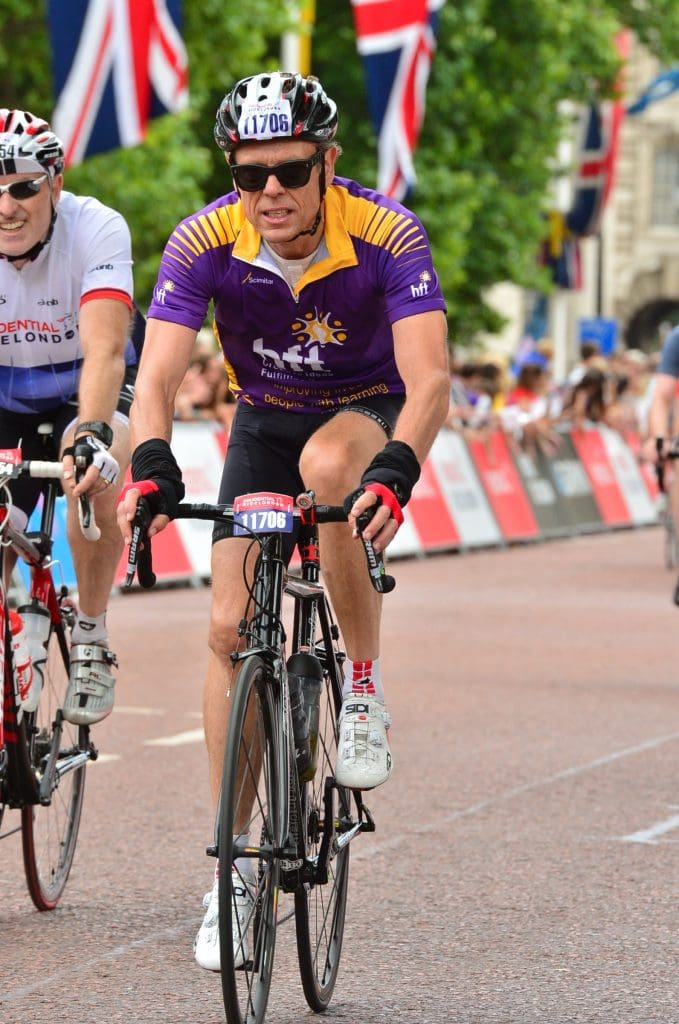
Rider training, however, is clearly a very good idea. The government’s Bikeability scheme, launched in 2006 and expanded in 2020, is designed to teach cycling skills to all children, from basic training to advanced. (By 2025, five million children should have had training.) It also offers courses for adults.
I would urge non-cycling Ti readers to try riding. Besides, the way things are going with regulations and autonomous driving, cycling may one day be the only way to enjoy freedom on our roads.
Plus, remember dear driver – and I’m aware my Ti audience will be more car driver than cyclist – almost every adult cyclist drives, and about a third of people with a driving licence cycle (according to Cycling UK). So, it’s really about ‘us’ – not ‘them’ and ‘us’.
And on that thorny question of who behaves worse: drivers or riders? I asked an independent expert, a friend who’s an HGV driver. ‘They’re both as bad as each other,’ says Simon. Simon drives an Audi R8; he also rides a bike.

