Features
Back to Library >
What Murray did next
5 years ago


He is not simply a man who knows what he wants, he knows how to get it too. Which is why the cars he designs are really manifestations of his personality on wheels. You feel it’s not that he chooses to design his cars that way – light, pure, powerful and uncompromised – but that he would be literally unable to do it any other way.
The vision is simple, but not obvious, because he remains as uninterested in speed for the sake of it as ever. When the McLaren F1 came out, it took four years before they bothered to find out its top speed. Gordon doesn’t care about 0-60mph times, Nürburgring records or downforce figures for road cars, because in his view, none of these considerations make a car better to drive. What does make a car good to drive? Light weight, naturally aspirated engines and manual gearboxes. And I’d wager plenty there’ll be few reading this who’d argue with any of that.
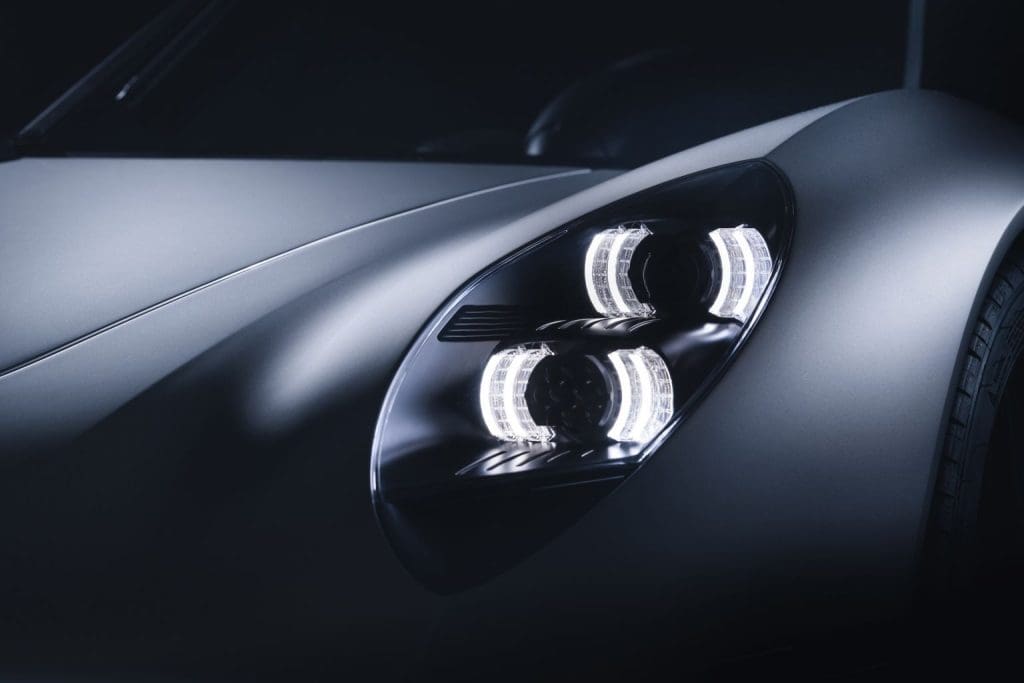
So the base specification of his new T.33 unveiled today will probably not be a great surprise. It’s an all-carbon, mid-engined naturally aspirated V12 coupé driving the rear wheels alone through a manual gearbox (though an Xtrac robotised manual will be available, which is as close as Gordon ever comes to compromise). And you may now be wondering how that differs from the already launched T.50.
According to Gordon, they are entirely different cars, which is how they present. Whereas the T.50 is more purposeful than pretty, the T.33 is absolutely gorgeous, and contains within its lines little cap doffs from Gordon to some of his favourite sports racers of the Sixties. He owns up to the Porsche 904-alike back end, but I can see Ferrari 250 LM in the rear wing and something else I can’t quite put my finger on around the front. Sometimes I think Lotus 23.

There’s something else quite different about it too: it only seats two people. This is partly because Gordon wants the central driving position to be exclusive to the more narrowly defined, even higher performance and far more expensive T.50, partly because this is, in his words ‘a supercar GT’ so maximising individual cabin space and ease of access is important, and partly because he has bitten the bullet and gone for full Federal certification, which costs eye-watering amounts of money but means he can sell it across the pond without let or hindrance. Unlike the T.50, whose US sales come with strings attached and could be stopped. And apparently the Feds aren’t fans of central driving positions.
This then is Gordon Murray doing a GT. Which in his head means an engine that’ll only spin to 11,100rpm rather than 12,100rpm like that in the T.50. The motors displace the same capacity, but block, heads and crankshaft aside, are completely different, the T.33’s being tuned to produce a mere 604bhp from 3.9-litres, which still gives 154bhp per naturally aspirated litre.

By comparison, Ferrari’s finest V12 de jour, the 819bhp motor in the 812 Competizione, offers just 126bhp per litre. Knocking the power back from the T.50’s 650bhp to 606bhp has enable Cosworth’s engineers to deliver 75 per cent of maximum torque at just 2500rpm, though if you want it all, you’ll need 9000rpm, which is rather unorthodox in any road car, let alone one claiming to be a GT.
But there are some concessions. We’ve learned already of the optional paddle-shift transmission (which he’s already regretting because, of the 50 cars he’d sold at the time we met, just three had been specced with two pedals) but it has power steering too which, of course, is hydraulic. And like the T.50 but unlike the old F1, there are power assisted brakes, ABS and switchable traction and stability control systems because, I guess, he couldn’t sell the car without them.

There remains so much of it that seems reassuringly old school, beyond even the V12 and stick shift: there are simple double wishbones at each corner, and a purely mechanical Salisbury limited slip differential and even a handbrake operated by, wait for it, your hand. Imagine that.
And it’s still light, phenomenally, ridiculously light when seen in the context of the performance it is likely to provide. A physically larger, better equipped, more comfortable and civilised machine than a T.50, it has as a result put on around 100kg. But it is still on course to come in at 1100kg or below, which is still some hundreds of kilos below any car of comparable performance.

Gordon will build 100 T.33s, starting early next year, then 100 more of a variant in 2024 (probably a more track-oriented car) and a further 100 of the final variant (which will have some kind of open roof) in 2025. And that will be that not only for the T.33, but Gordon Murray Automotive cars powered purely by internal combustion engines. After that Gordon concedes he’s going to have to make peace with hybrid design. A hybrid tied to a naturally aspirated V12 of course, but a hybrid nonetheless.
It is remarkable to see how driven Gordon remains. Half a century after he first entered the public eye by designing a Le Mans car for Alain de Cadenet which ran as high as fifth in the 1972 race, he remains as full of drive, determination and ideas as ever.

By his standards the T.33 is actually quite conventional; it doesn’t even have fan-assisted aerodynamics. By anyone else’s it’s a spaceship, albeit a rather analogue one. As for the money, it’ll be about £1.65 million once tax is included, which is around a million less than a T.50.
Which would I have given all the money in the world? I’m not sure, but I fear I may never have the talent to extract the absolute maximum from a T.50, but I know I could carry on gazing at the simple beauty of the T.33 into my dotage. Make of that what you will.


